A Professional's Take on the New Ecs Elitegroup Liva Z11 Plus Mini Pc
Category: Laptops (Mini PC editorial)
Introduction
The ECS Elitegroup Liva Z11 Plus Mini PC arrives in a market saturated with compact desktops and small-form-factor systems designed to replace bulky towers in both professional and consumer settings. This review examines the Liva Z11 Plus from a practical, professional perspective: how it performs in real-world scenarios, what buyers typically care about, and where it fits relative to alternatives. Rather than a spec-sheet rehash, the focus is on usability, expandability, thermal behavior, connectivity, and the kinds of tasks for which this mini PC is most and least appropriate.
Who should consider the Liva Z11 Plus?
The Liva Z11 Plus is aimed at users who want a balance between desktop-class capability and a compact footprint. This includes office and knowledge-workers who need reliable productivity machines, IT managers looking for small, centrally managed endpoints, creative professionals requiring a dedicated second workstation for editing or rendering tasks, and small-business owners seeking low-profile kiosks, digital signage, or POS systems. It is also attractive to home users who want a tidy media center or a small home lab node.
Design and build quality
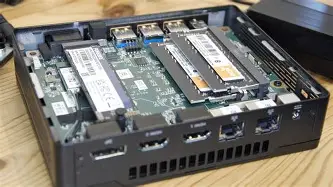
In the Liva line, ECS tends to prioritize a utilitarian but refined aesthetic. The Z11 Plus follows this approach with a chassis that is compact enough to sit unobtrusively on a desk or mount behind a monitor. Build materials and finish feel appropriate for office deployment: matte surfaces reduce fingerprinting and a minimal set of status LEDs keeps the design unobtrusive. For professionals, the two most important practical design considerations are serviceability and mounting options; the Z11 Plus generally offers easy access to memory and storage bays and includes standard VESA mounting capability for behind-monitor installations.
Performance and thermal characteristics
Performance in a mini PC is tightly coupled to configuration choices—CPU, storage, and memory. The Liva Z11 Plus is available in multiple configurations that span efficient ultralow-power processors to higher-performance mobile-class CPUs designed for sustained workloads. In everyday productivity tasks (web browsing, spreadsheets, video conferencing), even modest configurations deliver smooth, dependable performance. For heavier workloads such as video editing, 3D rendering, or compilation tasks, choosing higher-tier CPU and fast NVMe storage materially shortens task times.
Thermals are a perennial challenge in compact systems. ECS's thermal design for the Liva Z11 Plus balances noise and heat: under office loads the cooler runs quietly, making it suitable for open-plan offices and meeting rooms. Under sustained heavy load, temperatures climb as expected, and the system may increase fan speed. For professional environments where sustained peak performance is common, buyers should pay attention to configurations with better cooling options and consider external ventilation around the chassis.
Connectivity and expandability
A mini PC’s utility is greatly influenced by its I/O. The Liva Z11 Plus typically provides a sensible mix of modern connectivity: multiple USB-A and USB-C ports, at least one HDMI and/or DisplayPort video output for dual or even triple-monitor setups (depending on configuration), and a wired Ethernet port. For networking, integrated Wi‑Fi and Bluetooth offer flexibility, while a 2.5GbE wired port is increasingly common in recent devices and valuable for fast local file transfers and NAS access.
Expandability is where the Z11 Plus can shine for professional users. Commonly, the chassis accommodates at least one M.2 NVMe slot and user-replaceable memory modules, allowing upgrades to SSD capacity and RAM without replacing the whole unit. Some variants even include a 2.5-inch SATA bay for additional storage—useful for local media libraries or caching needs. The practical impact: businesses can standardize on a base model and extend life by upgrading storage or RAM as needs evolve.
Software, management, and security
Enterprise buyers will evaluate management and security features. The Liva Z11 Plus supports mainstream operating systems and standard security practices. Out-of-the-box, it is compatible with Windows and various Linux distributions. For IT-managed deployments, hardware-level features such as TPM support, secure boot capability, and BIOS-level management tools matter. While the specifics vary by SKU, ECS typically includes the necessary features for centralized fleet management, and the compact form factor fits well into managed desktop programs and thin-client replacement strategies.
Looking for the best Laptops & Computers deals on Amazon?
Browse Now →Real-world use cases
To make the assessment actionable, consider how the Liva Z11 Plus performs in several real-world scenarios:
- Office productivity: For standard office workloads the Liva Z11 Plus offers more than enough processing power, quick boot times from NVMe storage, and quiet operation suitable for open-plan spaces.
- Digital signage and kiosks: With its compact size and VESA mountability, the unit integrates easily behind displays. Reliable video output and long uptimes are essential here, and the Z11 Plus’s design supports these requirements.
- Media center and content playback: The system handles 4K streaming and local media playback with ease when paired with the appropriate GPU capabilities or hardware video decoding support in the chosen CPU.
- Light creative work: Photo editing and light video editing are acceptable on mid-tier configurations. Professionals performing heavy timeline-editing or color grading should opt for higher-tier models or a dedicated workstation.
- Home lab and edge computing: The small footprint and upgradeable storage make the Z11 Plus a good candidate for compact server nodes, edge devices, or development machines that run containerized workloads.
- Point-of-sale (POS): The reliability, small size, and sufficient peripheral connectivity make it a practical choice for POS systems where space and unobtrusiveness are priorities.
Comparison with common alternatives
Many buyers will weigh the Liva Z11 Plus against competitors. The table below summarizes how the Z11 Plus compares on practical attributes rather than raw benchmarks, which vary by configuration.
| Model / Category | Typical Target User | Strengths | Limitations |
|---|---|---|---|
| ECS Liva Z11 Plus | Office, digital signage, home media, small business | Compact, upgradeable storage and RAM, balanced thermals, VESA mountable | Performance depends on SKU; thermals limit sustained high-power workloads |
| Intel NUC (various) | Enthusiasts, small workstations, specialized deployments | High-end configurations available, strong ecosystem, good driver support | Often higher price for comparable specs; variable expandability |
| Minisforum / Beelink | Home users, mini workstations, compact gaming | Good value, some models with discrete-class GPUs, strong community | Support and warranty quality varies; some models trade build quality for price |
| ASUS PN / HP EliteDesk Mini | Enterprise desktops, managed fleets | Enterprise-grade manageability and support, rugged options | Often pricier; fewer high-performance consumer-style options |
Pros & Cons
Below is a concise pros and cons list reflecting the kinds of trade-offs professionals care about when evaluating a compact system such as the Liva Z11 Plus.
- Pros
- Small footprint and VESA-mountable design suitable for busy desks and hidden installs.
- Good selection of ports and networking options for connectivity-rich deployments.
- User-upgradeable RAM and storage help extend service life and lower total cost of ownership.
- Quiet operation under typical workloads, making it suitable for office and meeting-room use.
- Flexible for multiple real-world roles: office PC, media center, kiosk, or small server node.
- Cons
- Thermal limits in a compact chassis can throttle sustained heavy workloads compared to full-size desktops.
- Performance varies widely by configuration; careful SKU selection is required for demanding tasks.
- Internal expandability is still limited relative to traditional towers—no discrete full-size GPU options.
- Enterprise buyers should verify management features and warranty options as they vary across manufacturers and resellers.
Buying guide: What to prioritize
When considering the Liva Z11 Plus, buyers should align configuration choices with intended use. The guide below outlines priorities across common decision points.
1. Define the main workload
If the primary tasks are web, office, and conferencing, prioritize a balanced CPU, 8–16GB of RAM, and a fast NVMe boot drive. For creative work or development, choose higher-core-count CPUs and 16–32GB (or more) of RAM. For digital signage or kiosk use, focus on reliable video output and stable network connectivity.
2. Memory and multitasking
RAM is one of the easiest ways to improve perceived responsiveness. For multitasking or browser-heavy workflows, favor at least 16GB. If the system will run virtual machines, local development containers, or heavy creative apps, 32GB or more is preferable.
3. Storage: NVMe vs SATA
NVMe SSDs drastically improve boot times, application launch speed, and file copy times. If the model offers both M.2 NVMe and a 2.5-inch bay, a combination can provide both speed and capacity: NVMe for OS and apps, SATA for bulk media or backup.
4. Ports and displays
Confirm the number and types of video outputs needed. Many professionals expect at least two outputs for dual-monitor setups. Check the inclusion of USB-C with DisplayPort Alt Mode if a single-cable docking-like workflow is desired. Also consider legacy ports if connecting to older peripherals.
Shop the latest Laptops & Computers picks on Amazon.
See Deals →5. Networking
For file-heavy environments or local development that relies on NAS, a 2.5GbE wired connection offers a meaningful improvement over 1GbE. Wi‑Fi 6 (802.11ax) improves wireless throughput in dense environments and is useful for meeting rooms and offices where wired Ethernet is not available.
6. Noise and thermal expectations
Deployments in quiet environments should prioritize configurations verified for quiet operation. For sustained computational loads, consider placing the unit in a well-ventilated area or selecting SKUs with enhanced cooling solutions.
7. Warranty and business support
Business deployments benefit from extended warranty options and on-site support where available. Confirm the warranty period and support channels that come with the specific model or through your reseller.
8. Future-proofing and lifecycle
Choose configurations that leave room for incremental upgrades: extra memory slots, spare M.2 slots, and an accessible chassis. This extends usable life and may reduce longer-term replacement costs.
Deployment tips and maintenance
- When deploying multiple units, create a standard image with OS optimizations, management agents, and security settings to reduce configuration drift.
- Schedule periodic cleaning in environments exposed to dust; small fans in compact systems are sensitive to dust buildup and degraded airflow.
- Enable TPM and secure boot where the OS and workflows support them to harden endpoints against tampering.
- For 24/7 roles like digital signage or kiosks, configure robust power policies and monitoring to detect hardware issues early.
Verdict and natural conclusion
The ECS Elitegroup Liva Z11 Plus Mini PC is a practical entrant in the compact desktop space. Its strengths lie in a well-rounded approach to connectivity, upgradeability, and a quiet, compact design that suits a wide variety of deployment scenarios. For professionals evaluating a small-form-factor desktop, the most important consideration is matching the chosen configuration to the workload: a modestly equipped Z11 Plus will excel in office productivity and media playback, while higher-tier configurations or alternative platforms should be considered for sustained heavy compute or GPU-accelerated workloads.
Ultimately, the Liva Z11 Plus represents a sensible option for businesses and discerning home users who need a tidy, serviceable system that blends into modern workspaces. With careful SKU selection and attention to deployment details like cooling and network provisioning, it can serve as a reliable endpoint for years—delivering the compactness many buyers want without forcing disproportionate compromises in everyday capability.